
Quantitative Evidence That Ultrasound Probe Repair Is in Fact Repair — Not Remanufacturing
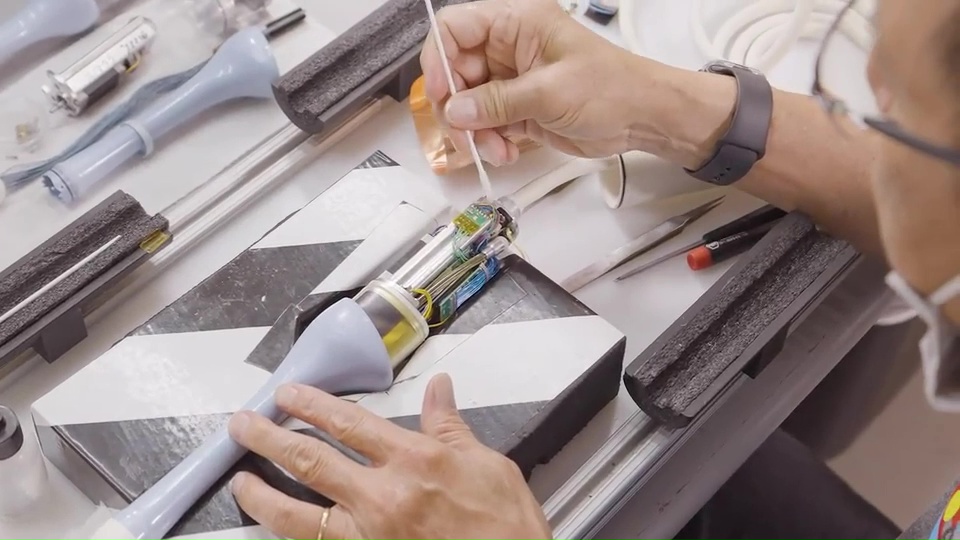
Quantitative Evidence That Ultrasound Probe Repair Is in Fact Repair — Not Remanufacturing
Accredited testing and traceable documentation to support safe return‑to‑service decisions and audit‑ready records.
Last Updated: 2/2/2026
The FDA’s Quality Management System Regulation (QMSR becomes effective February 2, 2026, and aligns manufacturer quality systems with ISO 13485. While hospitals are not regulated under QMSR, audit expectations increasingly focus on objective evidence, traceability, and defensible servicing determinations in outsourced ultrasound probe repair.
Hospitals retain responsibility for patient safety and return‑to‑service decisions. That responsibility depends on whether repair activities are supported by quantitative evidence demonstrating restoration to OEM‑characterized performance and safety attributes.
Multiple OEM Certified
Industry Highest Successful Probe Repair Rate
Cloud-Based Documentation
13485:2016 Certified
Years in Business, Sonora + Acertara
Probes Repaired Since 1998

What Hospitals Need on File To Defend Return-to-Service Decisions
The following artifacts not only support patient safety, supplier qualification, and traceable documentation during internal or external review but also reflect what auditors and risk committees typically request.
- RMA Chain-of-Custody & Decontamination Attestation: Supports safe handling, cleaning, and high-level disinfection responsibilities before and after shipment. (AIUM guidance; AAMI TIR99)
- Incoming Inspection Records (Visual/Functional): Documents condition on receipt and establishes baseline for acceptance-test comparisons. (ACR–AAPM ultrasound performance monitoring)
- Post-Repair Acceptance-Test Summary: Quantitative results generated using test methods that are similar or the same as what manufacturers use and that demonstrate restoration to OEM-characterized performance and safety attributes, reported against site-defined acceptance criteria (ACR–AAPM).
- Calibration & Equipment Traceability with Technician Sign-off: Test data must be tied to calibrated instruments and qualified personnel to support traceability. (ISO 13485/QMSR emphasis on records)
Note: Acceptance criteria are governed by each facility’s medical physics and quality-control program.

What Acertara Supplies
Acertara’s QMSR Toolkit consolidates evidence packets used to support defensible servicing determinations and return-to-service decisions.
- Repair Dossier (Sample/Redacted PDF): Work description, component traceability, photographs, and final test data.
- Acceptance-Testing Summary: Quantitative post-repair verification mapped to site-defined physics/QC acceptance criteria.
- Material & Component Characterization Summary: Hydrophone measurements, FTIR material analysis, acoustic impedance matching, and electrical/thermal characterization to support comparative evaluation of repaired components.
- Reprocessing & Packaging Guide: Clarifies cleaning and high-level disinfection responsibilities before shipment to Acertara and upon return to the facility. Probes are returned non-sterile and not in sealed sterile packaging; facilities must perform site-specific cleaning and HLD prior to clinical use, consistent with AIUM and AAMI TIR99 guidance.
- Pre-shipment Cleaning, Handling & Packaging Guidance: Aligned with AIUM and AAMI TIR99 for safe transfer and processing.
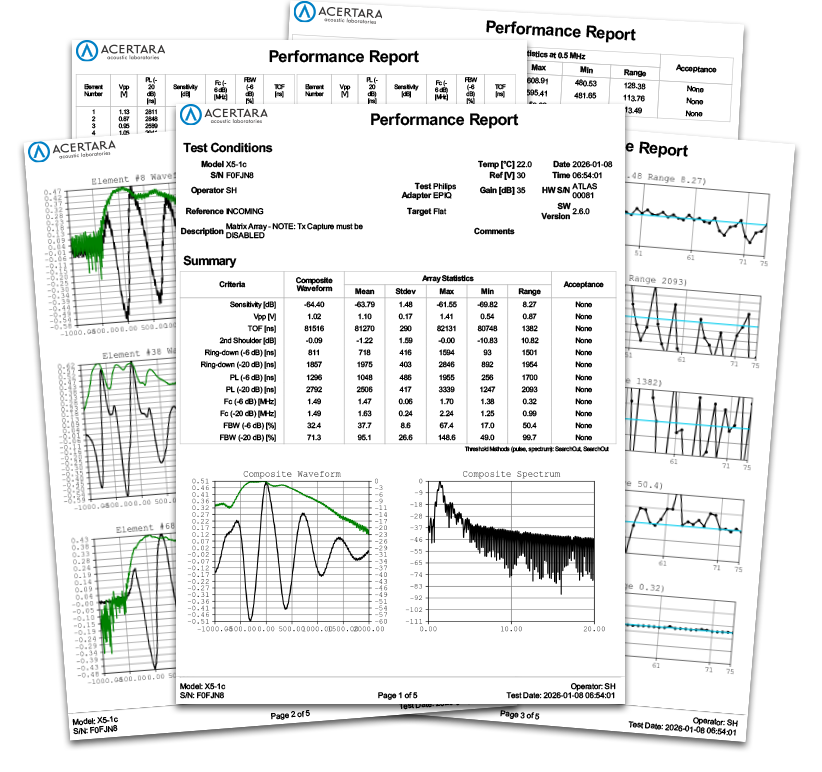
Sample pages from an Acertara repair dossier. Full redacted example provided after form submission.
Acertara’s QMSR Toolkit
Complete the form to access the Toolkit:
ASCA-Accredited, Manufacturer-Grade Testing Across Materials and Finished Probes
Acertara’s differentiation is an evidentiary chain that begins with accredited qualification of repair materials and components and ends with traceable, quantitative verification of the finished repaired probe.
- Accredited Qualification (Materials & Components): ASCA/ISO/IEC 17025-accredited testing used to characterize materials and components before their use in repairs, including hydrophone-based acoustic characterization, FTIR material analysis, acoustic impedance matching, and electrical and thermal characterization. These data establish validated material and process windows for specific repair actions.
- Per-Repair Verification (Finished Probes): Each repaired probe undergoes quantitative post-repair verification demonstrating performance restored within a tight, defined margin relative to OEM-characterized baselines. Results are reported as objective numerical findings, not regulatory determinations.
This evidence supports defensible conclusions that the activity constitutes servicing (repair) rather than remanufacturing as defined by the U.S. Food and Drug Administration.
Acceptance criteria are governed by each facility’s medical physics and quality-control program.
FAQs
Q: Why does quantitative testing matter after ultrasound probe repair?
A: Without quantitative testing, there is no objective basis to confirm that a repaired probe has been restored to OEM‑characterized performance and safety. Functional checks alone cannot support a defensible return‑to‑service decision.
Q: How does Acertara determine whether work is repair or remanufacturing?
A: Acertara evaluates its repair activities in accordance with the FDA’s remanufacturing guidance, using accredited, quantitative evidence to assess whether repaired probes are restored to OEM-characterized performance and safety without significant change. Acertara documents this assessment as part of the repair record. Regulatory determinations and return-to-service decisions remain the responsibility of the appropriate parties.
Q: Who defines acceptance criteria after repair?
A: Acceptance criteria are defined by each facility’s medical physics and quality‑control program (e.g., ACR–AAPM). Acertara reports measured results and supporting documentation.
Partner With Acertara for Ultrasound Probe Testing
We don’t assume performance. We measure it and prove it with precision ultrasound probe testing against defined tolerances.
- Regulatory-grade ultrasound probe testing for every repaired device
- Transparent data trails for audit, QA, or FDA inspection
- Confidence in performance without overpaying for OEM replacement
- Support from a vertically integrated engineering and testing team


Reach Us
We want to hear from you about your current probe repair challenges. Drop us an email or call and ask to speak to one of our awesome Customer Service Representatives.
1950 Lefthand Creek Lane, Longmont, CO 80501
+1 303.834.8413